Every year, Australian businesses pour millions of dollars into what boardrooms casually label "digital transformation".
In practice, this investment rarely resembles structural modernisation. More often, it amounts to a high-gloss cosmetic renovation: a slick customer onboarding portal, an AI-powered conversational widget, or an executive analytics dashboard rendered in sharp typography and vibrant charts.
On the surface, the business looks thoroughly modernised. The user experience is frictionless, the brand is energised, and executive presentations sparkle.
Yet beneath that polished veneer, the organisation’s daily operations remain stubbornly fragile.
Customer service teams still copy records across three disconnected legacy databases. Order fulfilment depends on a labyrinth of shared spreadsheets maintained by a handful of indispensable staff. Finance closes the books each month through heroic manual reconciliation, and frontline sales executives waste hours manually synchronising deals between their mobile devices, customer relationship management (CRM) software, and billing engines.
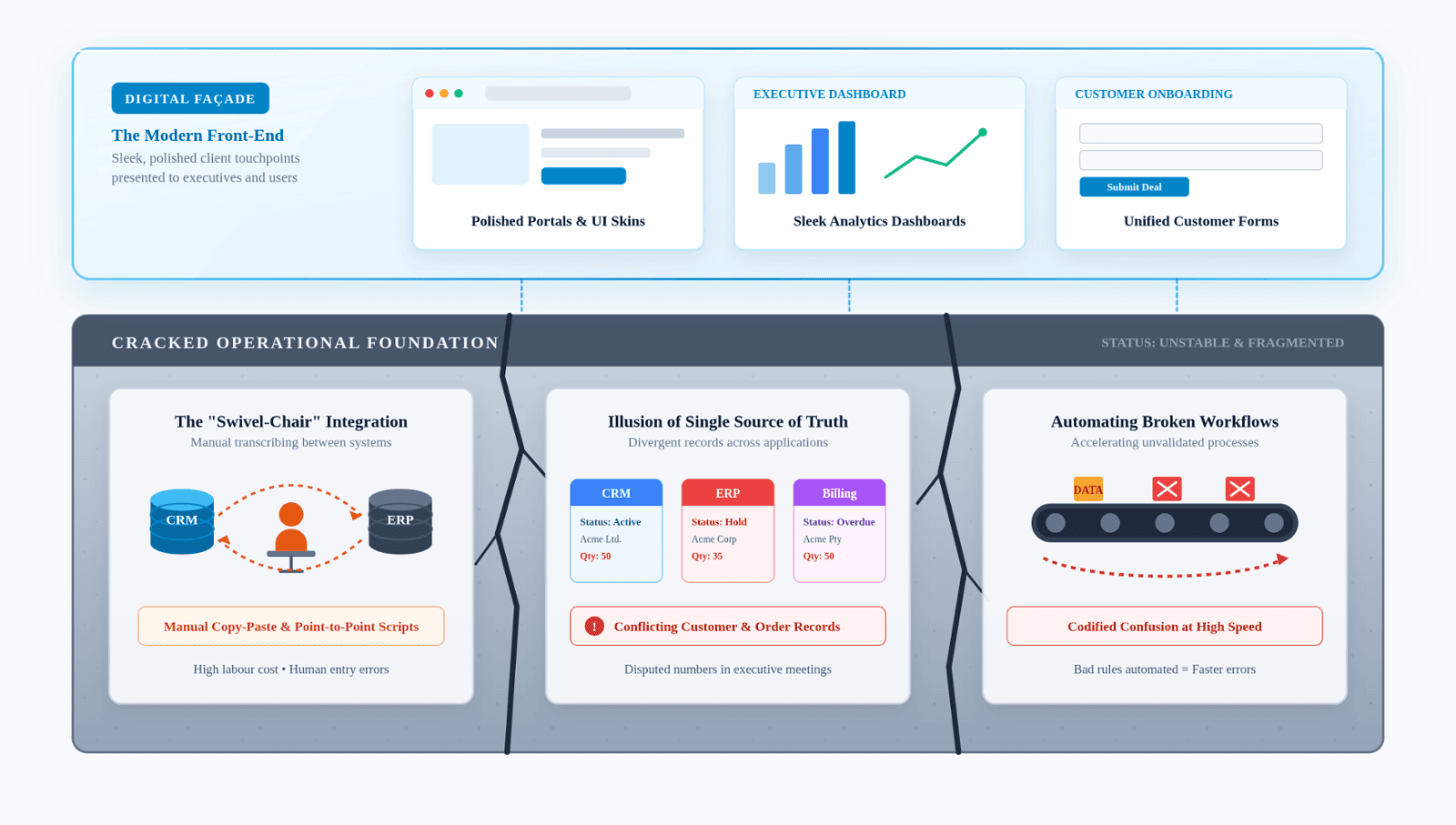
This is the Digital Façade—a thin, brittle layer of contemporary software stretched over cracked operational foundations.
If businesses want to build organisations capable of sustained scale, operational resilience, and genuine agility, they must abandon cosmetic transformation. As outlined in the foundational framework of Concrete Digital: The Digital Business in the 21st Century, businesses must treat digital systems with the same engineering discipline, load-bearing integrity, and durability as civil infrastructure.
The Anatomy of the Digital Façade
How do well-funded organisations with experienced leadership end up trapped behind digital façades?
It usually begins with a misdiagnosis of what digital transformation entails. Boards and executive teams naturally gravitate towards visual deliverables. A new mobile application or a visual dashboard can be demonstrated in a boardroom meeting within months; restructuring data topologies, auditing core operational handoffs, and rationalising master data registries cannot.
This bias drives three persistent architectural anti-patterns across growing businesses:
1. The "Swivel-Chair" Integration
When systems do not speak to one another natively or through a governed integration layer, organisations invariably invent workarounds. They install middleware tools, configure unmonitored point-to-point webhooks, or worse, rely on staff to manually transcribe information from one screen to another. The customer experiences a seamless digital form; the back office experiences administrative chaos.
2. The Illusion of the Single Source of Truth
Virtually every organisation claims to pursue a "single customer view". Yet when examined closely, customer records live simultaneously in the CRM, the enterprise resource planning (ERP) platform, the marketing automation engine, and the billing ledger—each with conflicting timestamps, divergent contact details, and separate transaction histories. Dashboards pull numbers from whichever database is most convenient, producing conflicting metrics and boardroom debates about whose numbers are correct.
3. Automating Broken Workflows
Automating an inefficient, poorly defined manual process does not fix the process; it simply accelerates the rate at which errors propagate. When organisations overlay automated workflows onto ambiguous business rules, they codify institutional confusion into their software stack.
| THE DIGITAL FAÇADE | THE CONCRETE DIGITAL FOUNDATION |
| Polished Portals & UI Skins | Unified User Touchpoints |
| Brittle Point-to-Point APIs | Governed Integration Layer |
| Siloed Databases & Sheets | Authoritative Master Data |
| Manual Back-Office Patches | Engineered Operating Engine |
What Is "Concrete Digital"?
In civil engineering, nobody assesses the structural safety of a commercial high-rise by inspecting the paint in the lobby. Engineers inspect the pilings driven into bedrock, the reinforcement in the load-bearing concrete cores, and the redundancy of mechanical services.
Concrete Digital applies the exact same mindset to solution architecture.
A digital business is not defined by its web presence or the number of SaaS licences it maintains. It is defined by the resilience of its underlying operational spine. In a concrete digital architecture, software tooling is subservient to the operating model, business rules are explicit and codified, and data ownership is unambiguous.
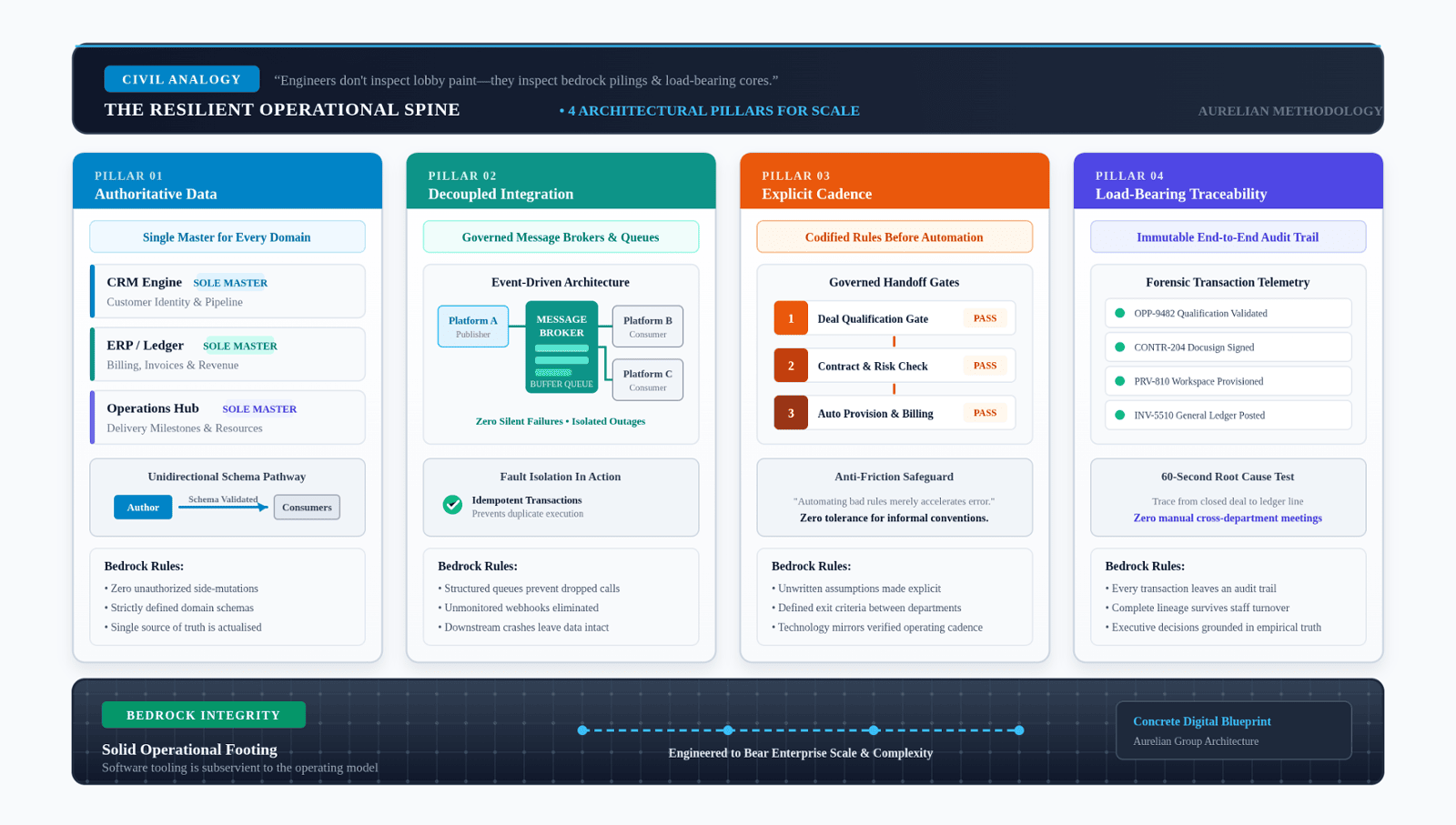
Building a concrete foundation requires deliberate adherence to four architectural pillars:
1. Authoritative Data Boundaries
In a well-engineered business, every data domain has exactly one authoritative master.
The CRM is the undisputed master of customer identities, pipeline governance, and deal qualification.
The ERP or Accounting Engine is the sole authority for billing schedules, revenue recognition, and commercial ledgers.
The Operations Engine is the sole authority for service delivery, milestone progression, and resource allocation.
Data flows along clear, unidirectional pathways. Auxiliary applications may consume or reference this data, but they never arbitrarily mutate it without formal schema enforcement and validation.
2. Decoupled, Observable Integration
Point-to-point connections between software platforms inevitably devolve into technical debt. When Platform A breaks, it silently corrupts records in Platform B, leaving administrative teams to untangle the damage weeks later.
Concrete systems rely on decoupled integration architectures. Data exchanges happen via structured message brokers or governed integration frameworks that feature comprehensive logging, transaction idempotency, and automated alerting. If an endpoint fails, transactions queue safely rather than vanishing into an unmonitored error log.
3. Explicit Operational Cadence
Before writing a line of code or deploying a single automated rule, business processes must be ruthlessly defined. Handoffs between commercial teams, legal review, credit checks, and delivery kick-offs cannot rely on informal hallway chats or unwritten conventions.
When operational workflows are clear, software configuration becomes straightforward. When workflows are murky, software becomes an expensive mirror reflecting internal friction.
4. Load-Bearing Traceability
A modern business must be able to audit the lifecycle of any transaction end-to-end without conducting a forensic investigation.
From the exact qualification trigger that advanced a prospect into an active opportunity, to the contract execution, automated provisioning, and subsequent tax invoice—every stage must leave a verifiable audit trail. This traceability is essential not only for governance and compliance, but for executive decision-making grounded in empirical reality.`
A 3-Minute Architectural Stress Test
To evaluate whether your organisation is operating on concrete foundations or merely sheltering behind a digital façade, run this simple operational diagnostic:
- Pick a recent closed-won client deal.
- Trace that customer record backward to its initial point of qualification: Can your teams demonstrate exactly what commercial criteria were met before it entered the forecast, without asking the sales rep to recall their meeting notes?
- Trace that same deal forward into delivery and invoicing: Did the sales agreement generate project scopes and accounting ledgers automatically, or did an administrator re-key line items into your finance system?
- Identify an unexpected billing variance or project delay: Can your leadership locate the root cause in your operational telemetry within 60 seconds, or does it require a cross-departmental investigative meeting?
Build Systems Engineered to Endure
osmetic modernisation feels rewarding because it produces immediate visual feedback. But superficial fixes compound technical debt and leave organisations fragile, incapable of scaling without disproportionate head-count expansion.
True transformation is an engineering discipline. It demands that leadership resist the temptation to treat business systems as decorative accessories. By prioritising robust architecture, enforcing clean data governance, and designing resilient operational handoffs, Australian businesses can stop maintaining fragile digital veneers—and begin constructing durable, scalable engines.
Step Behind the Digital Façade
Concrete Digital: The Digital Business in the 21st Century provides the foundational blueprint modern organisations need to anchor their digital operations. Distilling real-world architectural observations into clear, pragmatic recommendations, Aurelian Group Founder Matt Koopmans cuts through software vendor hype to demonstrate how to build true "concrete" foundations—aligning operating models, governing core data boundaries, and engineering business systems designed to scale.